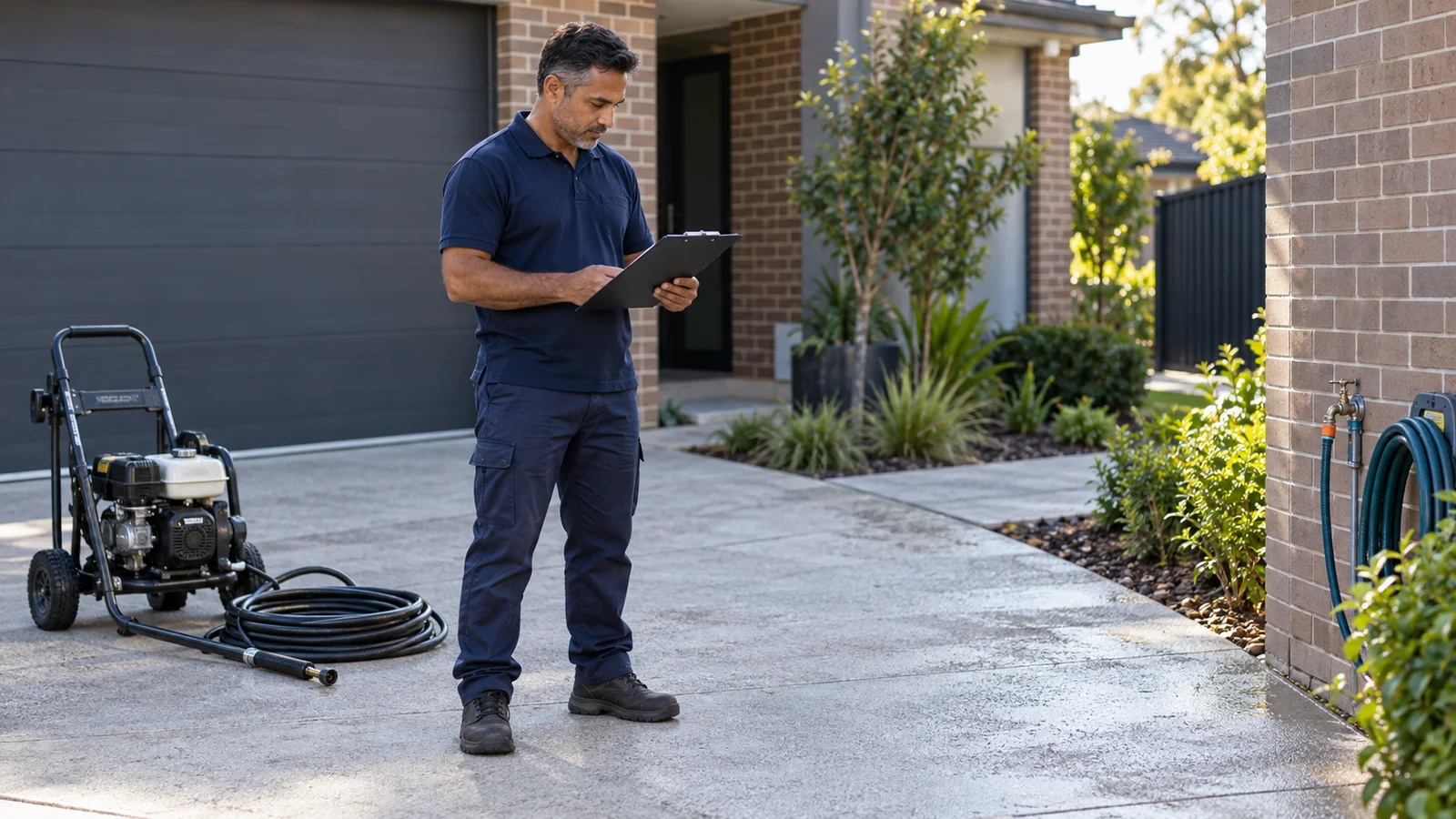
The cheapest site problem is the one found before arrival
Pressure washing operators describe the same practical surprises: an outside tap with poor flow, a locked gate, furniture across the work area, fragile fittings, pre-existing surface damage or nowhere suitable for wash water to go. Public operator discussions are useful evidence of the language and workflow, but they are anecdotes—not proof of how common each problem is.
A short pre-job check cannot replace an on-site risk assessment. It can, however, reveal whether the quote, equipment, access plan and appointment duration still make sense before the route is committed.
Copy this booking-and-arrival checklist
Use one intake for residential and small commercial work, then confirm the changing details on arrival. Keep the answers as observations rather than treating a customer's description as a technical assessment.
- •Site and contact: full address, reachable on-site contact and who can approve a change in scope
- •Work area: exact surfaces, approximate size, access path and any areas explicitly excluded
- •Water: tap location, hose connection, expected supply and who provides the water
- •Access: gate, parking, loading, stairs, shared drive, strata or building requirements
- •Surface condition: material, age where known, coatings, cracks, loose joints, stains and prior repairs
- •Nearby items: vehicles, furniture, plants, electrical fittings, doors, windows, cameras and pets
- •Runoff: slope, drains, garden beds, low points and a lawful containment or disposal plan
- •People and timing: occupants, neighbours, public access, noise constraints and a safe exclusion area
Plan the water and runoff path before the wash path
EPA NSW states that runoff from washing activities must not enter stormwater drains and recommends designated wash areas that direct wastewater to a collection pit and then sewer where permitted. EPA Victoria guidance likewise uses an impervious wash area draining to storage as an example of preventing wastewater from reaching stormwater. The exact lawful option depends on the contaminants, site, water authority and local rules.
Before accepting the job, identify where water is likely to travel and what it can pick up. A driveway that slopes to a street drain is a different job from a contained courtyard. Soap, oil, paint residue, sediment and biological growth may change what must be captured or how it may be disposed of. Do not promise that dilution or 'water only' makes discharge acceptable.
- •Mark every nearby stormwater inlet and low point
- •Ask what substances may already be on the surface
- •Choose containment, recovery and disposal methods for the actual site
- •Confirm any trade-waste or sewer approval before relying on that route
- •Stop and reassess if the site differs from the booking information
Record condition without pretending a photo proves everything
Walk the area with the customer when practical. Photograph existing cracks, loose coatings, damaged seals, stained sections and nearby items before moving or protecting them. Add a short written note that identifies the surface and viewing conditions.
Photos support a shared starting point; they do not replace insurance, a contract, product knowledge or a competent surface assessment. If asbestos or another hazardous material is suspected, stop. Do not disturb, scrape, pressure-wash or test-clean the material, even in an inconspicuous area. Obtain a competent assessment and the appropriate specialist advice and controls before any work. Never use high-pressure water on asbestos-containing material. For other uncertain surfaces, obtain competent advice before selecting a cleaning method rather than increasing pressure until something changes.
Build safety and public access into the appointment
High-pressure water can cause serious injury. Safe Work Australia publishes a guide for high-pressure water jetting, and WorkSafe Victoria notes equipment classes, maintenance, operator competence and personal protection requirements. Those sources cover high-pressure jetting hazards; they do not mean every domestic pressure washer falls into the same equipment class.
Follow the equipment manufacturer's instructions and the work health and safety duties that apply to the job. Keep people away from hoses, spray and wet surfaces; identify electrical and chemical hazards; and use appropriate controls, training and protective equipment. A booking app is not a safety system.
Turn the check into a route-ready job
Once the scope is accepted, convert the useful facts into an operational handover: contact, location, service window, expected duration, access, agreed surfaces, water arrangement, site notes and the next decision point. Keep regulated waste, chemical, safety and incident records in the systems designed for them.
- •Do not route an unconfirmed job as though it has a fixed duration
- •Allow separate time for set-up, containment, recovery and a final walk-through
- •Keep customer-facing arrival notes free of sensitive access details
- •Record approved scope changes before continuing
- •Close the job only after the work area, equipment and access points are checked
Where DayRoute fits—and where it does not
DayRoute's verified workflow keeps the accepted customer's contact, job location, time, duration and operational notes together. Its route planner can order the day's stops and show travel estimates, and completed work can move into the invoicing flow. That suits the handoff from a confirmed site check to the operator's day.
DayRoute does not assess a surface, calculate safe pressure, test water flow, choose chemicals, design runoff controls, verify disposal approval, replace a SWMS or risk assessment, or establish legal compliance. Use competent judgement, manufacturer instructions and current regulator and water-authority guidance for those decisions.
Turn the advice into today's run sheet
Plan up to 10 jobs with Google Maps travel estimates. Sign in by email for 10 free route calculations per account, then continue planning in the DayRoute app.
Related pages
Sources and scope
- SafeWork NSW — Managing risks of exposure to asbestosReviewed 12 October 2026. High-pressure water must not be used on asbestos-containing material; suspected hazardous material requires competent assessment before disturbance or test cleaning.
- EPA NSW — The drain is just for rainReviewed 8 October 2026. Supports keeping washing runoff out of stormwater and using an appropriate wash-water collection route. Site and disposal requirements still depend on the actual waste and local approvals.
- EPA Victoria — How to implement controlsReviewed 8 October 2026. Gives an impervious designated wash area draining to storage as an example control to prevent wastewater reaching stormwater. It is general risk-control guidance, not a site-specific approval.
- Safe Work Australia — Guide for managing risks from high pressure water jettingReviewed 8 October 2026. Supports the serious-injury and risk-management boundary for high-pressure water jetting. Equipment classification and duties must be applied to the actual system and jurisdiction.
- Pressure-washing operator discussion — pre/post checklistsReviewed 8 October 2026 as public operator language only. It mentions water connections, obstacles, existing damage, runoff and final checks; it is anecdotal and not evidence of prevalence or legal requirements.